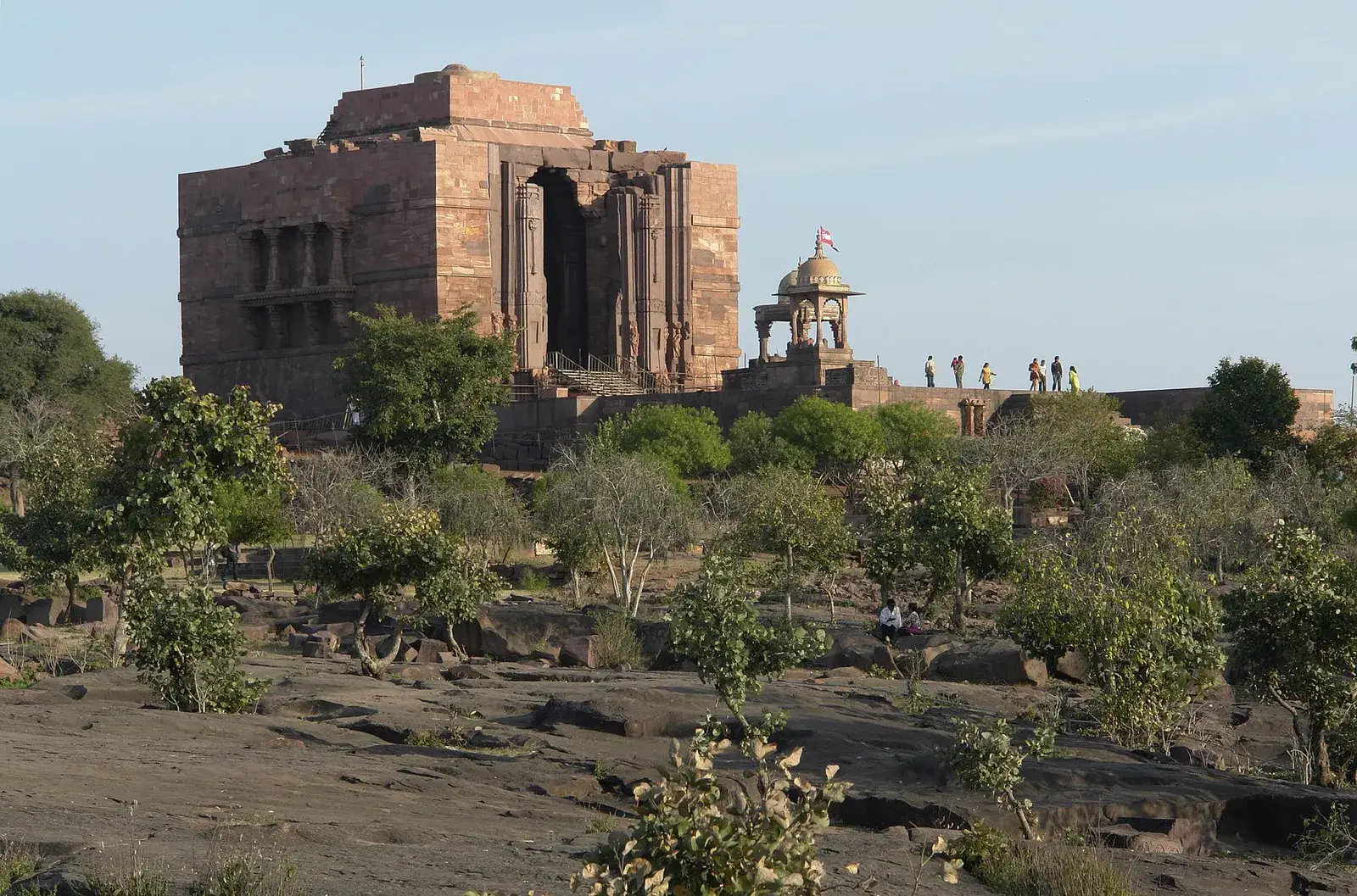
A walled city on a clifftop, abandoned for four hundred years, the Narmada valley dropping away far below. That is Mandu — and it is one of the most atmospheric places in all of India.
The Malwa Sultanate called it Shadiabad: the City of Joy. When the Mughals arrived in the 1560s and the last sultan fled, the city slowly emptied. The jungle crept in, the roofs fell, the population drifted away. And in that slow emptying, Mandu was preserved. No one built on top of the palaces. No city grew over the mosque courtyards. You still walk through a medieval walled city, more or less as it stood when it was alive.
The love story
You cannot understand Mandu without the story of Baz Bahadur and Rani Roopmati.
Baz Bahadur was the last Sultan of Malwa — less a warrior than a musician and poet, more devoted to his art than to statecraft. One telling has him hearing Roopmati sing from a great distance and being immediately captivated. She was a Hindu singer, he a Muslim sultan; she agreed to come to his court on one condition — that her palace be built so she could see the Narmada river from its windows every morning.
He built it. You can still stand in Rani Roopmati’s Pavilion, at the very southern edge of the plateau, and see the Narmada glinting silver on the valley floor below. The room where she slept, the columns she leaned against. It is quiet and ruined and extraordinary.
When Akbar’s general Adham Khan invaded in 1561, Baz Bahadur fled. Roopmati, facing capture, is said to have taken poison rather than be taken. Baz Bahadur spent the rest of his life as a wandering musician at Akbar’s court, composing ghazals about the woman he had lost. The story entered the repertoire of north Indian classical music and has stayed there ever since.
The monuments
Jahaz Mahal — the Ship Palace — is the most photographed structure in Mandu. A long, two-storey palace built between two tanks, it looks from a distance like a ship floating on water. It was supposedly the harem of the sultans, said to have housed thousands of women. The scale is theatrical.
Hindola Mahal, the Swing Palace, gets its name from dramatically tilted walls that give the impression of swaying. The corbelled vaults and the quality of the stonework are exceptional.
Hoshang Shah’s Tomb deserves a long look. Built around 1440, it is widely considered India’s first marble mausoleum — a full two centuries before the Taj Mahal. The proportions are perfect, the white marble inlay delicate. Shah Jahan sent his court architect to study it before designing Agra’s great monument. You can see why.
The Jami Masjid, modelled on the Great Mosque of Damascus, is large, severe, and still in use. Baz Bahadur’s Palace, in the valley below Roopmati’s pavilion, has ornate columns in remarkably good condition. The Rewa Kund — the tank Roopmati supposedly bathed in — sits below her pavilion, still holding water after six centuries.
The Taj Mahal connection
The Hoshang Shah’s Tomb paragraph above is not legend — it is documented. Shah Jahan recorded, through his court historian, that he dispatched senior architects to Mandu to study the tomb’s proportions and construction before work began at Agra. The marble dome, the slender corner towers, the symmetrical garden setting that you now associate with the Taj — these ideas were being worked out here, on a clifftop in Malwa, two hundred years earlier.
The monsoon secret
Getting there
Mandu is about 290 km from Bhopal — roughly five hours by road via the Dewas bypass. There is no convenient direct bus from Bhopal. The closest well-connected city is Indore (about 100 km from Mandu), which has trains and flights from major cities. If coming from Bhopal, plan an overnight at Mandu itself — it is too far and too rich to be rushed through as a day trip.
MP Tourism’s Malwa Retreat and Malwa Resort sit on the plateau, surrounded by ruins and farmland, with the valley view at the edge. That setting is part of what you are paying for.
Fees and timings verified July 2026 against MP Tourism and ASI. Entry fees are subject to revision — confirm at the ticket counter on arrival.