In most Indian wildlife parks, the forest is something you observe through a jeep window. At Satpura, you walk into it. Armed forest guard ahead, tracker reading the ground, your own footsteps finding the rhythm of the trees — the pace drops to human speed and the forest becomes something else entirely.
This is what separates Satpura from every other national park within reach of Bhopal, and from almost every park in India.
What the walking safari actually feels like
You set out before the heat, into the buffer zone. The guard’s rifle is there, but after a few hundred metres you stop thinking about it. What you start noticing is the monitor lizard that hasn’t registered you yet. The fresh pugmarks of a leopard crossing the track an hour ago. The way a spider’s web catches the first light between two bamboo stems. A sloth bear print in the soft mud, the claw impressions wide and deep.
Walking through a forest at ground level — not in a vehicle, not above it — changes what you see. You notice the dung beetles working. You hear the difference between a langur’s alarm call (relaxed chatter becoming urgent bark) and a deer’s alarm snort. You see the full texture of the forest, not just the large mammals. It takes two to three hours, and it is among the most unusual wildlife experiences available in India.
Walking safaris run inside the buffer zone only — not the core zone — with a maximum group size of six, and must be booked in advance. The number of permits per day is strictly limited. That limitation is exactly what makes them good.
The boat safari on the Denwa
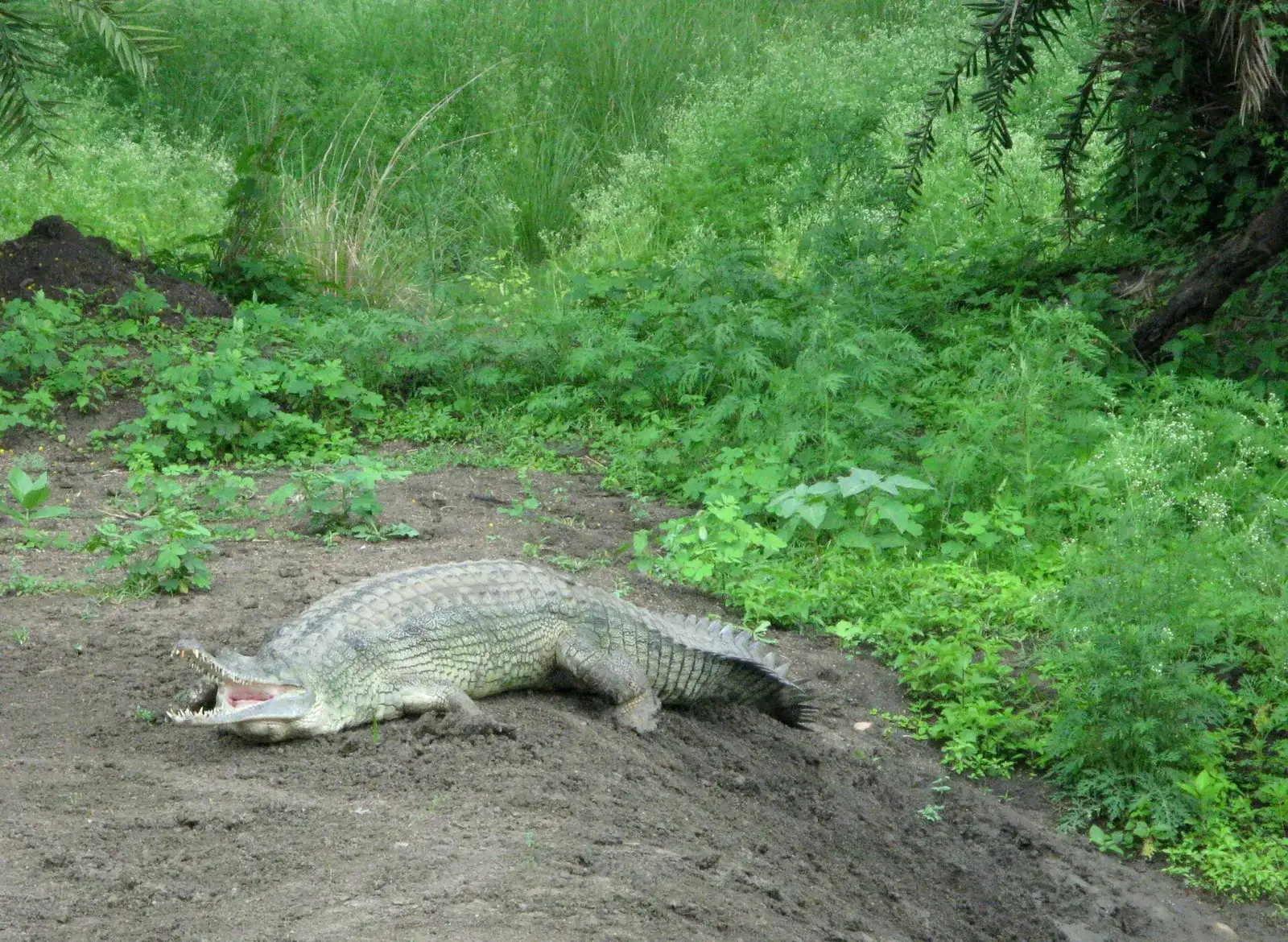
At dawn, you step into a flat-bottomed boat on the Denwa backwaters. Mist sits on the water. A marsh crocodile is already out on a sand-bank, mouth open, absorbing the morning. Herons pass overhead in pairs. An Indian smooth-coated otter dives and surfaces again.
The Denwa reservoir cuts through the heart of the reserve, and the water’s edge is where animals come to drink. In the right conditions, you may see a leopard or tiger on the bank — animals that move differently when they don’t hear a jeep engine. Even without the big cats, the boat safari at Satpura is extraordinary: two hours on still water, surrounded by forest, in a silence that most wildlife parks have long since lost.
Wildlife: what to expect
Satpura is one of the best parks in India for sloth bears — you have a genuinely good chance of a sighting, particularly in the early morning. It is also excellent for leopards, which are shyer but more numerous here than in the more heavily visited parks. Tigers are present throughout the reserve. Gaur (Indian bison), chital, sambar, wild dog (dhole) and Indian giant squirrel are all seen regularly. Crocodiles and gharials inhabit the Denwa.
The birding is first-rate — over 300 species recorded, including forest owlets, malabar pied hornbills and brown fish owls. Serious birders should come November to February.
Getting there and staying over
Satpura is about 140 km south of Bhopal on NH-69 toward Itarsi, then east toward Madhai — roughly three hours by car. The nearest railway station is Itarsi Junction, about 30 km from the park entrance.
Madhai village is the main entry point. Churna Island — a small island in the Denwa river — is where the best-value premium lodge sits, entirely surrounded by water and forest. Forest rest houses at Madhai are excellent budget options and often have the most atmospheric setting.
Book all safaris online at mptigers.gov.in before you arrive. Walking safari slots fill up weeks ahead in peak season. Arrive in Madhai the evening before your first dawn safari — the drive from Bhopal is not one you want to do before sunrise.
Timings, fees and park closure dates verified July 2026 against MP Tourism, Forest Department and mptigers.gov.in. Monsoon closure dates vary each year — confirm before travel.